|
|
|
 |
W./O
Vernon Marcel Jacques is on the left together with Flt Lieut.D.A.McDougal
and Sgt.N.G.Hildyard. This photograph shows the men after being
lifted to safety' aboard the New Zealand steamer Hororata. An article in
the Melbourne Herald dated July 6, 1945 tells of their rescue, how a sailor
looking through a porthole saw Albatross circling far off'. |
| I
occasionally ask my mother to tell me again how she felt then, waiting for news
of the lost men. She talks about the long nights, sitting at Nanna's small fire,
not warm enough to keep out the cold, or to give comfort. My Pop, silent as always,
staring into the coals, his index finger in his mouth. '...and in the water, in
the middle of Bass Strait with the sea rising as high as a mountain, three men
sat huddled inside a rubber dinghy, hanging on for dear life through storms that
sent big ships to safe harbours. Their anson bomber ditched in a sea wilder than
cape horn. One of those men was my dad, my dad...' 'Albatross' (Making Wings)
| | | | |
| The
picture on the right shows the sensitive face of a young John James Jacques,
my great grandfather. He and his brother William were Lighthouse keepers on most
of the islands and coasts around Tasmania. An obituary dated the 8th October
1908 speaks of his early days, the many exciting whaling experiences whilst
sailing between Fiji, Mauritius and Hobart'. In finding his grave in 1997
at the Bluff Lighthouse Devonport Tasmania, I felt a shift, a sense of belonging
that I'd not experienced before, about my own past and place. These were people,
ancestors, with connections to the sea and to Tasmania, a whole history to explore
that maybe, will bring answers.
|
 |
| | | |
|

Thomas Brown My first visit to Flinders in May 1998, was shared with
my son Yuri. Mother and son on tour of discovery! At the Emita museum, we
came across the history of the Brown family, Lighthouse keepers from the 1800's.
Charles Christie Brown, a Norwegian captain, had married Maria Louisa Jacques
and together they had nine children. Thomas Archibald the youngest, born on Goose
Island, had written a poem 'The Lightkeeper's Lament' when he was sixteen.
He was then, living with his family, on Deal Island in the Kent group. The Brown's
history included a newspaper account of Thomas'death. Ten years later, in a freak
accident a calm sea 'suddenly rose' drowning Thomas and his best friend Leslie
Wynne. Both were buried on the Inner Sister Island off the north end of Flinders
Island.
I
read the poem into my tape recorder and also the poignant and detailed newspaper
report. Maria Jacques, I later discovered, was a daughter of Mary Mann and John
Jacques, my great great grandparents. This
photograph of Thomas and his fiancee' 'Sissie' Florio, had been in the Jacques/Green
family album as unknown for many years, it wasn't until I came across the same
picture in the Port Welshpool Museum four years later that I was able to name
it.
'...Nothing but the deep blue ocean. Greets his eye from year to year. What
a dismal dreary outlook. His lonely life to cheer...' The Lightkeepers
Lament, Making Wings

Lighthouse The Bluff light beats a warning Mirrors the lantern
where no man now keeps watch Or shouts for help or Hoists the black sphere
that marks the tides Here in the click of hot shadows In the pounding
current of fear Ghosts trace foundations Move through dark caves Dance
needle sharp grasses Sing home the albatross Somewhere here Through
trees lying flat against the wind Maybe a sign A path that shows the way
Or the smell of memory kept For five generations Voices curl and
whisper on the slap of the sea Play on feathery wind Bob and knock,
and now On it's ledge of rock The anchor hooks in, holds fast Name
the voices Lean to the curving moon Breathe stars Run a vein through
the ragged sea For I've found it Faint words in grey stone Broken
on a rise of grass The grave of the lighthouse keeper

I had made plans many times to go out to both Goose Island and the Inner Sister.
Each time, the weather made the trips impossible. The stretch of water between
Flinders and the Sister Islands, is narrow and the sea can be treacherous. Go
with 'local knowledge only' was suggested and in May 2002, the plan and 'local
knowledge' came together. Alan Wheatley, a fourth generation islander would take
us across the following day, to look for the grave of Thomas Brown and Leslie
Wynn. ...so we crossed the sisters passage to inner sister island, the deepest
waters in bass strait, a whorl of oily sea, rising and falling, like the breast
of an unseen monster... jj journal
It
was not that easy. After trekking almost the whole of the island, stepping with
care through vast snakey tussocks, we met with, and were given directions from
two fella's who just happened to be on the island hunting. Thank you! Both men
knew the grave well and had even 'fixed it up a bit', without knowing whose grave
it was. It was a moving experience, finally standing at the grave of this distant
cousin of mine, paying respect.
...so we crossed the sisters passage to inner sister island, the deepest waters
in bass strait, a whorl of oily sea, rising and falling like the breast of an
unseen monster...(jj journal notes)
| | | | |
|

I'm
standing on the beach at Thunder and Lightning bay Cape Barren Island. My son
Yuri took this picture. We'd flown over to the island in Hugh Sinclair's single
engine plane, four of us squashed into the cabin along with supplies for the island.
After bouncing across the airstrip (paddock) to land on Cape Barren, Hugh suggested
we walk down the track, not far, to Thunder and Lightning Bay' Two hours and many
kilometres later, we found ourselves scrambling through the undergrowth and on
to the beach, exhausted. Funny one Hugh, but it was worth it, an extraordinary
place that holds powerful feelings. Recently, a friend sent me information about
the descendants of Mannalargenna chief of the Ben Lomond Tribe (Plangermaireener
nation) Tasmania. His forth daughter was Wobberertee, there are different ways
of spelling her name, however, they translate as Thunderstorm, Thunder and Lightning.
Thunder and Lightning Bay is named after Wobberertee.
|

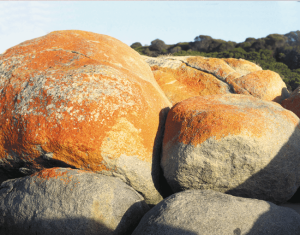
May
2002 I'm standing on just one of the many majestic orange lichen granite rocks
on Cat Island in the babel group of the Furneaux Islands. Lindsay Luddington from
Flinders Island, was going out in his boat, Strait Lady, to pick up a group of
young scientists and botanists who had been on the islands for a week weeding
out the box thorn. What a lively and inspiring group of young people, all dedicated
to caring for these pristine areas. Sandro and I were invited to go along for
the ride to help load up the gear. They didn't need any help at all, so we were
sent off to explore Cat Island. These remote islands have not altered since they
came out of sea, except for box thorn and other introduced weeds. Also changed,
possibly forever, is the depletion of seal and gannet colonies on these islands.
|

| |
| |
 |